Friday, September 30

The Anti-Fountain of Youth Protein: Methionine

Tuna is still one of the most healthful sources of protein, but...
Bottom line: a 40% decrease in calorie consumption over the adult life of an animal has been confirmed for decades to dramatically increase the healthy lifespan of the animal.  And now, researchers are finding that animals eating a normal amount of calories each day but decreasing protein (or, specifically, methionine) intake by 40% over the animal's life has similarly dramatic anti-aging effects.

There's one specific building block of protein that's the main culprit in causing cell damage and aging: methionine.  It's in all the most common protein-laden foods we like to eat, from eggs to beef or chicken to vegan options like tofu and algae.  (But keep in mind some foods have proteins with more of the methionine building block than other foods.)

Here's a useful, extensive listing of all the most common...and not so common (it might not be such a struggle to decrease your Beluga whale or free-range elk consumption!) foods with the highest amount of the methionine protein per serving.

Even the healthy egg should be eaten in moderation.
Ummm yeah, so the amino acid methionine seems to be completely unavoidable!  So we all need protein to live, and no matter which food our protein source is, it seems we're going to end up eating methionine in the food.  So, why would I even bother to tell you this?

Well, luckily scientists found in their studies that there were huge reductions in the amount of aging-type cellular damage found in the animals with just a 40% decrease in methionine intake.  That's great news!  Forty percent is a completely reasonable decrease that still lets us get our basic protein needs met.

Replace a few meaty dishes each week with a hearty veggie alternative and you're well on your way to drastically decreasing how much methionine you eat.

By the way, this research is an exciting extension on the decades of laboratory research on "dietary restriction" (DR) or "caloric restriction" (CR) in creatures varying in complexity from yeast to mice to monkeys.  Piles of research agreed that these DR or CR diets in which the number of calories was decreased by some signification portion (often around 40%) succeeded in increasing high-quality lifespan dramatically in all these creatures.  This result has been one of the best and most universally supported research findings in medicine.

Only recently have the researchers been studying each part of the diet one at a time...and that's when they found this gold mine result that the protein intake--specifically, the methionine intake--was the main factor that caused this increase in lifespan.

Monday, August 1

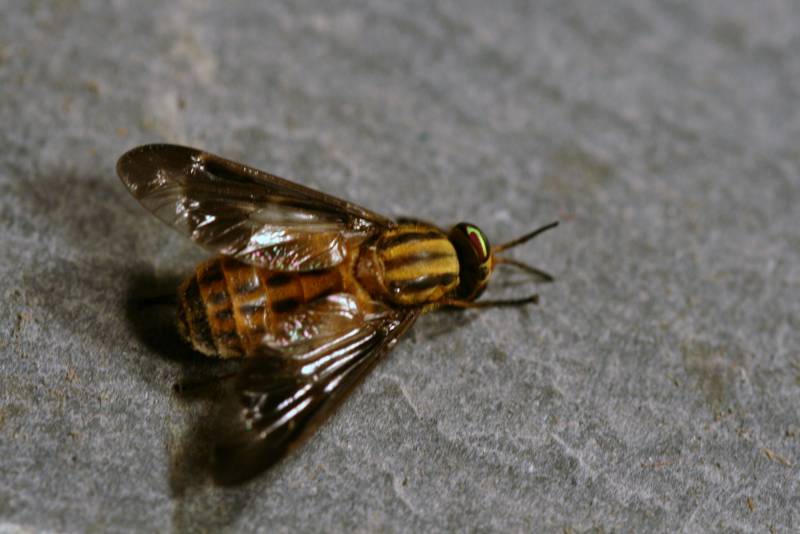
Why Deer Flies Don't Like Yellow Lab Ears


German Shepherd puppy
Horse
Yellow lab puppy
Which one doesn't belong?


Deer Fly photo Copyright Biology Dept. of Randall & Schietzelt & Harper College
My mom and I were walking the German Shepherd puppy (above) and a yellow lab puppy (above) this morning in rural NY.  A nasty deer fly (huge bloodsucking crazed insect) was hovering over the Shepherd puppy bugging the poor guy to death.  The yellow lab, only feet away, never got bugged at all!

So I got a theory about how this devil's fly finds its target.  I remember reading that bees find the entrance to their hive by depending a lot on the shapes of the area near the hive, like what pattern the trees are in and other big shapes like rocks as orientation landmarks.  If the landmarks are moved, the bees have trouble finding the hive.

So, I thought, maybe deer flies use certain shapes as their guides.  The horse and Shepherd ears have a distinctive M shape and maybe the flies learned to go there since the skin is soft and vulnerable there.
 
If the deer flies depended on the shapes (vs. smell or just randomly landing on any spot on the animal) then that would help explain why the lucky yellow lab with droopy ears had no problems at all.

Thursday, July 28

Immune Conditioning: How to Get a Drug Response Without Taking the Drug

Sherbert instead of pills?  Count me in!
I learned about immune conditioning today and boy did it blow me away!  I was reading The Healing Mind that the body is physically able to have a drug response without actually getting the drug.  Immune conditioning research was motivated by patients taking drugs to suppress their immune systems, usually for when patients have an autoimmune disorders or when the patient is getting an organ transplant.  In both cases, the immune system starts attacking good tissues, so a major treatment is to mute the immune system to stop the attacks.

Researchers wanted to know if they could somehow use less of the immune-suppressing drug and still get a good result.  Turns out you can, you just need to do some Pavlov-type conditioning like Pavlov did with his drooling dogs.

All you need to do is pair taking the drug with some combination of stimulus like a taste, sound, or sight.  After consistent repetition, research shows that you can stop taking the drug and keep giving the taste, sound, or sight cue.  The body will still act as if it's getting the drug. 


This has even worked for humans when researchers paired a drug with white noise and sherbert.  Yummm. 

Caveat: the body's response without the drug is usually not as strong as with the original drug.  But even so, immune conditioning is used widely in the medical world to slow down how fast the body rejects a transplanted organ or to help decrease the drug dose needed by patients who need immune-suppressant drugs.

(This also explains the curious allergic response some people get to pictures of something they're allergic to.  The person's immune system is conditioned to have an allergic reaction when it sees the allergen, even when the allergen isn't even there.)

Wednesday, July 27

Welcome to My Bookshelf

Several hundred books line the walls of my living room.  Most are non-fiction and about 2/3 of them come from the UVa Library; the rest I own.  Of course, I can't be reading all of them at once.  (But most of them are reference books anyway, so they're not really meant to be read cover to cover.)

At any given time, I'm focusing on a handful of the books for reading and studying.

To easily show you which ones I'm reading, I added a page to my site called Bookshelf.  Check it out for pictures of my current reading list.  "Bookshelf" is one of the tabs near the top of this page.

Monday, July 25

10 Reasons Donating Blood is Good For You

"We're out of luck Marge...this one's already donated this summer, too."

Helping trauma victims and surgery patients make it through their ordeals is a good enough reason to donate.  But why not add reasons why it's good for you, the donor?  Here are 10 benefits of blood donation:

  1. Cancer prevention  The more you donate blood (eligible every 56 days) the lower your risk for liver, lung, colon, throat and stomach cancers.  Wow, I had no idea...
  2. Protect your heart  Florida Blood Services found that if you donate regularly, you are 88% less likely to get a heart attack and one third less likely to get a stroke.
  3. "Helper's High"  People who volunteer get a release of endorphins which will make you feel happy for doing good.
  4. Discipline & willpower  Ok, most people, even the regular donors, wouldn't say they love getting stabbed with a big ol' needle.  But getting yourself to go anyway even though you're helping someone you won't meet and you're getting health benefits that are hard to notice is great practice for developing discipline.  That's a virtue that will spill over into all parts of your life from relationships to work promotions.
  5. Reduce iron levels  High blood iron levels are linked to heart disease and blood donation lowers blood iron levels.  This is especially critical for guys since they tend to have higher iron levels and higher levels of heart disease risk.  You'll also be replacing old blood with young, clean new blood, so donating is a great blood rejuvenator.  
  6. Mini free checkup  Keep an eye on some of your basic health statistics.  Before you donate, the nurses will measure and tell you your blood pressure, pulse, iron levels, and sometimes even cholesterol.  This gives you earlier notice or any changes in these important numbers and a faster response might make all the difference.
  7. Immune boost  Volunteers have higher levels of immunoglobin A, a critical part of your body's immune system.
  8. Meet new people  It's always easiest to make new bonds with people when you're going through the same experience, so chatting with other donors in nearby chairs is a great way to keep your mind off the needle and to make new friends.   The types of people who came out of their way to donate are probably nicer than average anyway.
  9. Free blood tests  Donors' blood is tested for many rarely-tested viruses and disorders like West Nile Virus and Hepatitis.  If the blood tests positive, they let the donor know, which helps them prevent further spread and get early treatment.
  10. Have a productive day!  No matter what else happens that day, you're guaranteed to have a productive day since you donated blood someone will get to use and no one can take that away.